Strongerdailylife

Journal

Notes from the floor, 2026.

Four pieces on how we actually run the studio: writing a block, training around a desk week, returning to load after a clinician’s note, and why a fifth person does not join a group of four.

12 March 2026

How we write a 12-week strength block

A block at Strongerdailylife is a short document, usually two pages. Page one names the lifts that will carry load, the weekly frequency, and the review date. Page two is the first four weeks in enough detail that a covering coach could run Monday without a conversation. We write it in the room at the end of the intro, while the screen is still fresh. People leave with a copy. If a line is unclear, it is cheaper to rewrite it that afternoon than in week five.

Starting loads come from what we saw, not from a formula on a phone. If a squat looked even at 40 kg for five, that is where week one begins. We would rather under-set the first fortnight and climb than spend three weeks negotiating with sore knees. Accessory work is listed as a menu: two or three options, picked on the day from how the main lifts felt. That is the only part of the block designed to move inside the twelve weeks.

The review date is in the diary before the first loaded session. We repeat a squat variation, a hinge, a press, and a carry or a short bike piece. Numbers go on the same sheet as the intro. Missed sessions are written down without a speech. The next block is built from that sheet and from the log, which is why we bother to keep one. A programme you cannot reread is a programme you cannot repeat.

7 May 2026

Training around a desk week in Jalan Besar

Desk with a laptop beside a window

Most of the people who train here sit. They sit in offices along Lavender, at City Square, in shophouses on Jalan Besar, and on the train home. A 55-minute session has to fit that week, not fight it. That is why our morning slots start at 06:30 and the last evening session is done by 21:00. It is also why we keep conditioning short. A twenty-minute row after a squat day is useful. An hour of mixed intervals on a Wednesday night, on top of ten thousand steps of commuting, is how people stop turning up.

Warm-ups for desk-heavy weeks spend more time on the upper back and hips than a textbook strength session would. We still squat, hinge, and press. We do not replace the lifts with a mobility class. The positions taught in the first ten minutes — a hip opener you can do at a desk, a wall slide, a calf stretch against a chair — are the same ones we take on site for workplace groups. Repeatable beats novel.

If a week is unusually heavy at work, the block already has a lighter session written in: fewer working sets, same lifts. You do not need to invent a new plan by text at 22:00. Tell the coach at the door. The log will show a down week, and the review will still have something honest to look at.

18 July 2026

What a return-to-load block actually contains

Return-to-load is the name we use when someone arrives with a clinician’s note. The note is the first thing we read. It tells us what has been cleared, what is still restricted, and whether the clinician wants a copy of what we do. We do not add a diagnosis of our own. We do not stretch the clearance. If the note says no running, there is no running, even if the bike feels easy.

The block is shorter between reviews — four weeks, then eight — because the first month is where a plan either holds or needs a quieter accessory. Sessions are one-to-one. Loads start below what the person remembers from before the injury. That is often the hardest sentence in the intro. The log is dated, and we will share it with the clinician if the client asks. Pain that changes during a set stops the set. We write down what happened and we do not guess why in medical language.

People sometimes want this format because it sounds more careful, even without an injury. We still ask them to use ordinary one-to-one. Return-to-load is for a documented clearance. Mixing the two makes the floor harder to run and the notes harder to read.

2 September 2026

Why we keep small groups at four

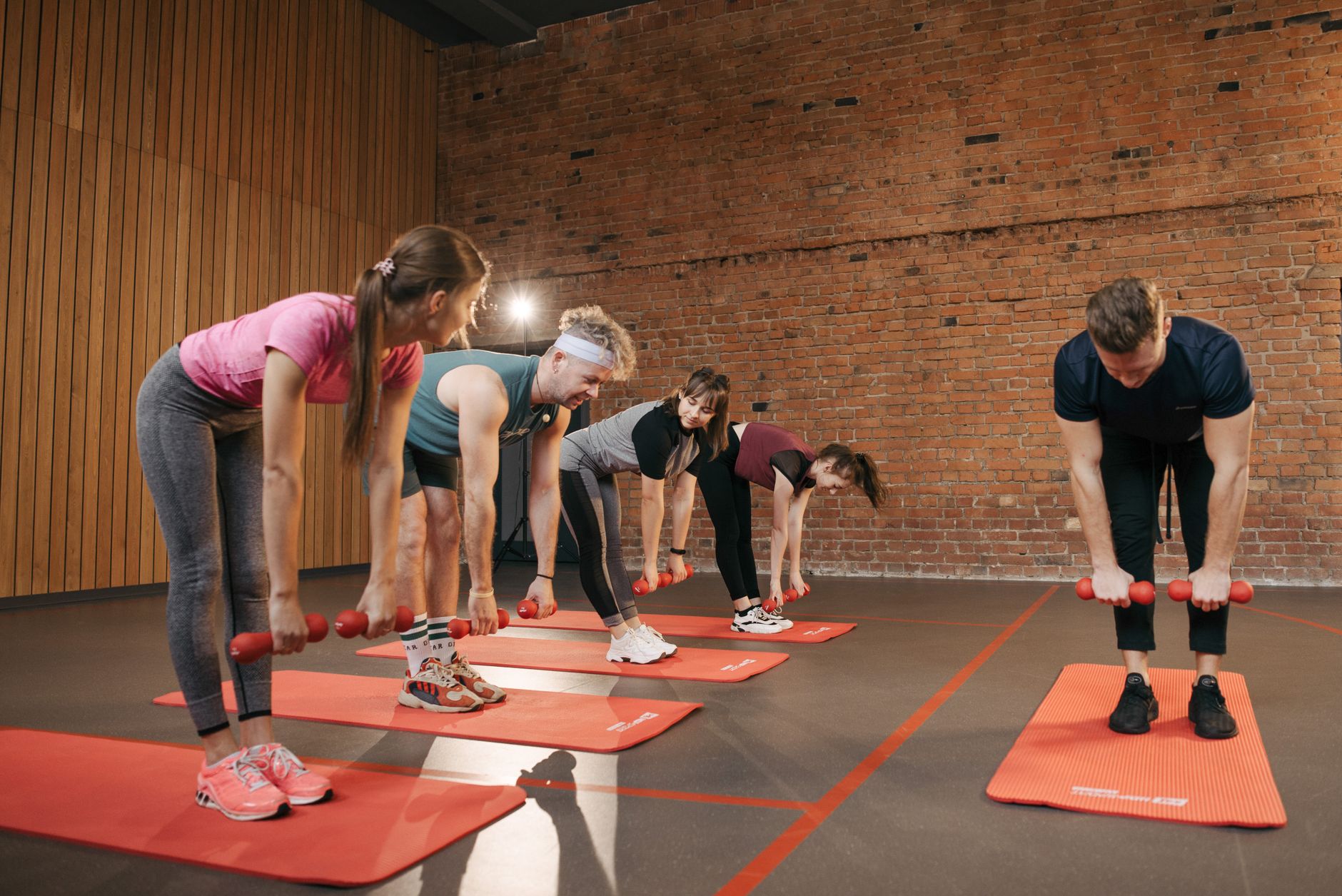
Four people hinging with dumbbells in a line

Four is not a brand number. It is the most people we can have on the floor in one hour and still log every working set. Two racks can be busy at once. A third person can be on a cable or a carry. A fourth is warming up or writing loads. A fifth person means someone is waiting, or a coach is watching two bars that should not be loaded at the same time. We have tried the maths on paper. It does not hold at five.

Each person in the group still has their own block. That is the other reason for the cap. If the hour becomes a shared workout on a whiteboard, we have stopped doing the job we sold. Shared time is useful — you keep a slot, you see the same faces, you are less likely to cancel — and it only works if the coaching still looks like coaching.

When a group fills we open another at a nearby hour rather than stretch the cap. That is slower to grow and easier to run. If you want more of a coach’s eyes, one-to-one is the format. If you want a class with a shared workout, another studio will be a better fit. We would rather say that at the intro than in week six.